Oak Island’s latest breakthrough: swamp structures, ancient tunnels and a mystery that refuses to die
Oak Island’s latest breakthrough: swamp structures, ancient tunnels and a mystery that refuses to die
For more than two centuries, Oak Island has guarded its secrets beneath layers of mud, timber and stone. Treasure hunters, historians and skeptics have all taken their turn on the tiny island off Nova Scotia, convinced that they might be the ones to finally crack its legendary curse. Most have left with little more than theories.
Now, a fresh sequence of discoveries – from swamp structures and Viking-era clues to a 17th-century tunnel beneath the Garden Shaft – is forcing even long-time doubters to take notice.
The question facing Rick Lagina, his brother Marty and their so-called “Fellowship of the Dig” is no longer whether something happened on Oak Island. It’s who was here, how long ago – and what exactly they were trying so hard to hide.


From pirate legends to Viking-era possibilities
For generations, Oak Island has been linked to tales of pirates and buried riches. Local lore still whispers that “one more person must die before the treasure is found” – a grim reminder of earlier casualties in the Money Pit.
When Rick and Marty Lagina arrived, backed by a television network and modern technology, they inherited centuries of failed expeditions. Their ambition was to do something different: let science, not superstition, lead the way.
Alongside metal-detecting expert Gary Drayton and veteran machine operator Billy Gerhardt, Rick turned his attention to a place many earlier searchers had dismissed – the island’s swamp. In recent years the team has recovered numerous artefacts there, including ship-related items dated to between the 15th and 18th centuries, hinting at a long maritime history.
In 2020, a large section of what looked like ships’ railing was recovered from the southern shoreline. Testing suggested it could be as early as the 8th century – a result so unexpected that it forced the team to widen their thinking.
Historian Dr Simon, working with the Laginas, went further. He suggested Oak Island might have been active during the Viking era, potentially as a staging point or harbour centuries before pirates ever entered the story. Suddenly, the hunt was no longer just about a single cache of gold. It became a study of layered, overlapping histories.
A buried wall in the swamp
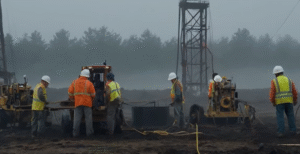
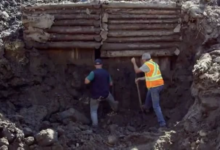
The swamp’s importance grew again when Billy and Gary uncovered an old wooden structure buried deep in the southern sector. As they cleared away mud and vegetation, a substantial wall began to emerge along the swamp’s edge.
The find immediately recalled earlier work by the late Fred Nolan, the famed surveyor and former Oak Island landowner. Nolan had identified what he believed was a centuries-old wooden wall in roughly the same area, and argued that it had been built to conceal something of value.
Now, with a known ship’s railing and a newly exposed wall sitting close to a mysterious stone pathway, the modern team faced a tantalising question: were these pieces of one integrated construction – perhaps a harbour, loading area or concealed causeway?
“That is old. It’s a handmade spike – that’s impressive,” Billy remarked as the crew recovered fastenings from the structure, underlining its potential importance.
Science in the swamp
To move beyond speculation, Rick brought in geoscientist Dr Ian Spooner to examine the structure and the swamp that contained it. Spooner’s expertise in soils and sediments has become one of the production’s quiet pillars.
On site, he noticed red sediment beneath the wooden feature that closely matched layers under the nearby stone road. The similarity suggested a linked construction period – and perhaps a single, organised group behind both features.
If the wooden wall, stone path and the long-rumoured “treasure tunnel” near the Money Pit are truly connected, they point not to ad-hoc digging by opportunistic treasure hunters, but to a coordinated engineering effort. In other words, an organised, possibly technologically advanced group once operated on Oak Island with a clear purpose in mind.
Fragments of timber with rounded edges and flat tops only deepened the mystery. How old were they? Could the swamp’s low-oxygen environment have preserved them for centuries? And if so, who had built them – Vikings, early European explorers, military engineers or unknown visitors?
The Garden Shaft and the tunnel below
While the swamp work continued, another storyline gathered pace at the centre of the island: the Garden Shaft.
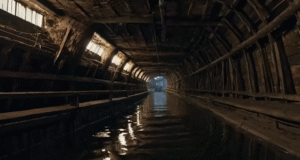
Originally sunk in the 19th century, the shaft has been re-opened and deepened by contractors Dumas Mining, with the aim of intersecting promising underground anomalies. By the time it reached around 90 feet, the team encountered a tunnel running westwards towards an area they call the “Baby Blob” – a zone where earlier water tests had detected high levels of silver, gold and other metals between 80 and 120 feet down.
“Well, here’s the deal, Rick – you could be standing a couple of feet above the tunnel we’ve been looking for for at least two years,” one worker remarked, underlining the significance of the moment.
The plan was simple but risky: drill into the tunnel, recover material and let the lab results guide the next step. The hope was that this passage might be part of the fabled treasure tunnel system linking the Money Pit to other parts of the island.
Hurricane Lee and an unwelcome pause
As momentum built at both the swamp and the Garden Shaft, nature intervened. Hurricane Lee, a powerful Category 5 storm, began tracking towards Nova Scotia.
For safety reasons, Rick and his team reluctantly halted all field operations. Equipment was secured, excavation zones were reinforced and key structures were protected by crew members including Leroy, Roger and Keo.
It was a frustrating pause at a time when the Fellowship felt closer than ever to meaningful answers. Yet the storm also offered something Oak Island rarely gives – time to reflect.
Rick used the forced break to review progress and plan the next steps. For him, the mission had clearly evolved beyond a simple chase for “pirate loot”. The aim now was to understand who built the tunnels, roads and walls, and why they invested such effort here.
A military button and new suspects
Before the storm hit, another clue had emerged at a circular stone feature elsewhere on the island – a foundation some believe may contain soil brought from the Money Pit.
As metal-detecting resumed around the structure, Gary Drayton’s detector locked onto a strong signal. Jack Begley dug carefully and unearthed a remarkably well-preserved button. Its design – three cannons and three dots – resembled military buttons known to have been used by French, British and Spanish forces.
Team member Fiona Steele suggested the object could be a key piece of evidence. If the button belonged to someone involved in organised activity on Oak Island, it opens the door to new theories: was the island once used for a military operation, supply depot or clandestine mission linked to European powers?
The find added a geopolitical dimension to a mystery already crowded with Vikings, pirates and secret societies.
Dating the tunnel – and raising the stakes
The most important data, however, came not from metal, but from wood.
Earlier in the year, core samples taken from the tunnel beneath the Garden Shaft were sent for carbon dating. The results suggested the timbers could be nearly 400 years old – pointing to construction in the 1600s, well before the Money Pit was first recorded in the late 18th century.
Later, Rick, Alex Lagina and Scott Barlow joined engineer Roger Fortin at the Dumas site office to review updated dating and structural reports. The implication was stark: unknown individuals were excavating and shoring tunnels on Oak Island long before modern treasure hunters arrived, and long before the island’s “curse” entered popular folklore.
That raises difficult questions. Who had the skills, resources and motivation to build such works in the 17th century? And what were they trying to protect – valuable cargo, sensitive documents, or something else entirely?
A decision to stop digging – for now
In parallel with these encouraging discoveries, Oak Island’s caretakers recently took the surprising decision to halt further excavation, citing safety and broader concerns.
Drilling had revealed a large underground void around 90 feet down, consistent with a major tunnel or chamber. Combined with the age of the timbers and the complex network of voids, roads and structures, the picture is of a sophisticated underground system whose full stability is not yet understood.
For now, this has forced the Fellowship of the Dig to pivot. They are shifting towards analysis, modelling and targeted sampling instead of aggressive excavation – a move that may frustrate some viewers but could prove crucial in preserving the site.
What happens next is uncertain. Core samples, dating reports and geophysical surveys will continue to drip-feed information. Each item – from a centuries-old beam to a single military button – adds one more fragment to a puzzle that began long before television cameras arrived.
But one thing is clear. Between the swamp structures, the 17th-century tunnel and the newly identified voids, Oak Island can no longer be dismissed as a simple pirate tale.
Something significant happened here. The only question is whether the island will ever allow the full story to be told.