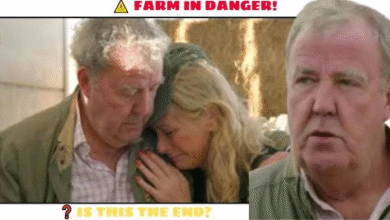
The Revolt That Shocked Westminster: How Clarkson’s Army Forced Starmer To Surrender
From Fields to Whitehall: How Jeremy Clarkson Became the Unlikely Voice of Britain’s Farmers
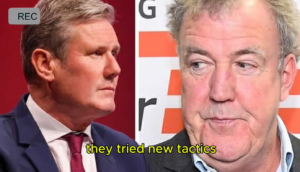
At 9:47am, the first tractor rolled into Whitehall. Then another. And another. Within minutes, the road leading to the heart of British government was filled with slow-moving machinery, steel wheels replacing buses and taxis, engines rumbling where ministers usually hurried between meetings. Police attempted to divert the convoy, but the farmers kept coming.
Westminster had seen protests many times before. This one felt different. These were not seasoned campaigners with placards and chants. They were farmers who had driven through the night from Scotland, Wales, the South West and northern England. And at the centre of it all stood an unexpected figure: Jeremy Clarkson.
Once known primarily as a motoring journalist and television host, Clarkson was now addressing thousands of farmers from the back of a flatbed truck. The reason they had gathered was a policy announced weeks earlier that had sent shockwaves through rural Britain.
A Budget That Changed the Mood
In October 2024, Chancellor Rachel Reeves unveiled Labour’s first Budget since returning to power. Among its measures was a reform to agricultural inheritance tax. Farms and agricultural land valued above £1m would face a 20% tax on inheritance.
At the dispatch box, the policy was framed as a technical correction. A loophole, Reeves said, had allowed wealthy landowners to shelter assets in farmland while avoiding tax. From the Labour front bench, Keir Starmer nodded in agreement. To ministers, it was a question of fairness.
To farmers, it felt existential.
Farmland, they argued, is not liquid wealth. A family farm might be valued at several million pounds on paper, but generate modest annual income. When a farmer dies, their children could face tax bills far beyond what the business can sustain. Paying the tax often means selling land. Selling land means the end of the farm.
For weeks, farming groups warned that the policy would hit ordinary family farms, not just wealthy estates. They struggled to be heard. Then Clarkson intervened.
Translating Policy Into Reality
Clarkson had bought Diddly Squat Farm years earlier, initially as a personal project. Over time, he became a full-time farmer, documenting the experience in the Amazon Prime series Clarkson’s Farm. When the tax changes were announced, he responded in the way he knew best: plainly.
In a short video that spread rapidly online, Clarkson stripped away the technical language. “They’re taxing tractors,” he said. “They’re taxing barns. They’re taxing the land your grandfather worked. And when you can’t pay, you’ll be forced to sell.”
Within hours, the clip had been viewed millions of times. What had seemed like niche tax policy suddenly felt personal to people far beyond farming.
Labour initially dismissed the intervention as celebrity commentary. But Clarkson possessed something ministers lacked: credibility with rural communities and an audience that trusted him. Farmers began organising, not through traditional unions, but via social media, messaging apps and Clarkson’s platforms.
The message was simple: come to London. Bring your tractor.
A Movement Gains Momentum
On 19 November 2024, more than 10,000 farmers converged on Westminster. The scale surprised both police and politicians. Clarkson’s speech that day was unscripted and direct. He spoke of families, generations and the quiet labour that keeps supermarket shelves stocked.
Inside Number 10, officials recognised the difficulty of the moment. This was not a group easily marginalised. Attempts to question the protest’s legitimacy quickly faltered when Clarkson brought farmers themselves onto television screens: dairy farmers, sheep farmers, young successors facing impossible choices.
As weeks passed, demonstrations continued. Tractors blocked roads. Rural communities mobilised. Clarkson remained omnipresent, using interviews, columns and social media to keep attention focused.
Ministers defended the policy with figures and assurances. Clarkson countered with stories.
Political Consequences
By early 2025, the political impact was measurable. Polling showed Labour’s support in rural constituencies eroding. By-elections confirmed the trend. In farming areas, inheritance tax emerged as a decisive issue.
The government attempted recalibration. Consultations were announced. Thresholds discussed. Payment terms reviewed. To protesters, it sounded like delay.
The tension escalated further when farmers staged a one-day national stoppage, disrupting food deliveries to major cities. For the first time, urban voters felt the knock-on effects. Farming was no longer an abstract concern.
Behind the scenes, Labour backbenchers from rural seats began to express unease. Publicly, the leadership held firm. Privately, the pressure was mounting.
A Forced Rethink
In November 2025, one year after the tractors first arrived in Whitehall, Reeves returned to the dispatch box. The inheritance tax policy was revised again. Thresholds were raised significantly. Exemptions broadened. Payment periods extended.
Ministers insisted the changes reflected listening and refinement. Few believed that narrative. The original proposal had been fundamentally diluted.
On his farm, Clarkson offered a brief reaction. “They blinked,” he said.
For farmers, it felt like relief. For Labour, it marked a bruising episode that exposed a gap between policy intent and lived reality. And for Westminster, it raised an uncomfortable question.
Beyond Politics
Clarkson did not seek office. He did not form a party. He returned to farming and filming. Yet his role in the episode has altered assumptions about influence.
The protests showed how quickly public figures with large platforms can mobilise communities that feel ignored. Not through ideology, but through shared experience and plain language.
For Keir Starmer, the lesson was stark. Government power remains formidable. But in an age of fractured trust, legitimacy can be challenged from unexpected places.
As tractors eventually left Whitehall and normal traffic resumed, the memory lingered. In the contest over Britain’s farms, authority did not rest solely in parliament. It was shaped in fields, online feeds and voices that people recognised as their own.
And that may prove to be the most lasting legacy of a protest that began, quietly enough, with a single tractor rolling down Whitehall.