Oak Island Season 13 : Evidence Suggests a Hidden Dock Lies Beneath the Swamp
Oak Island Season 13 : Evidence Suggests a Hidden Dock Lies Beneath the Swamp
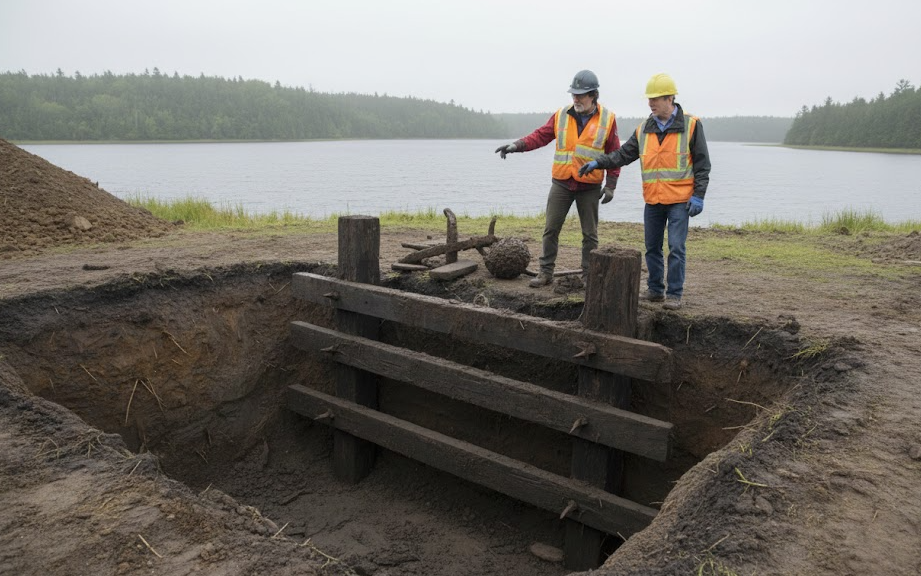
A Discovery That Begins With Patterns, Not Luck
Season 13 continues to challenge long-held assumptions about Oak Island, and Episode 3 may quietly introduce one of the most consequential ideas yet. For years, the swamp has been debated—was it natural, altered, or entirely man-made? Now, new data suggests a far more intentional origin.
The breakthrough didn’t come from a single artifact, but from patterns. Following Emma Culligan’s laboratory analysis and a growing concentration of finds on Lot 5, the team expanded scanning operations toward the western edge of the swamp—an area largely overlooked in previous seasons.
What they found immediately raised alarms.



Using ground-penetrating radar, seismic imaging, and electromagnetic surveys, the team detected long, straight linear features beneath the swamp bed. These anomalies weren’t chaotic or organic. They were parallel. Evenly spaced. And oriented toward the shoreline.
Rick Lagina’s reaction said everything:
“That doesn’t look natural… that looks built.”
Timbers Buried Where Nature Doesn’t Place Them
Further investigation revealed submerged wooden beams embedded deep within the marsh. But these were not driftwood or fallen trees. The beams showed clear signs of human modification:
-
axe-cut edges
-
consistent sizing
-
deliberate spacing
Radiocarbon analysis delivered the real shock. The wood dated back centuries earlier than expected, predating known colonial settlement in the region. That alone forces a rethinking of who may have been active on Oak Island—and when.
Dr. Ian Spooner added another unsettling layer. Sediment analysis indicated that the swamp’s composition does not match a naturally formed wetland. Instead, it suggests intentional flooding, consistent with long-standing theories that the swamp was deliberately created to conceal what lay beneath it.
With aligned timbers, engineered spacing, and unnatural sediment layers, the idea of a buried dock moves from speculation to serious hypothesis.
Why a Hidden Dock Changes the Entire Story
If the swamp conceals a dock, the implications are enormous.
It would mean Oak Island was not discovered by chance.
It was not a random dumping ground.
It was a planned point of arrival.
Mahone Bay’s geography would have allowed small vessels to approach unnoticed, avoiding major trade routes. A concealed dock would explain how materials, manpower, and artifacts arrived without leaving obvious historical footprints.
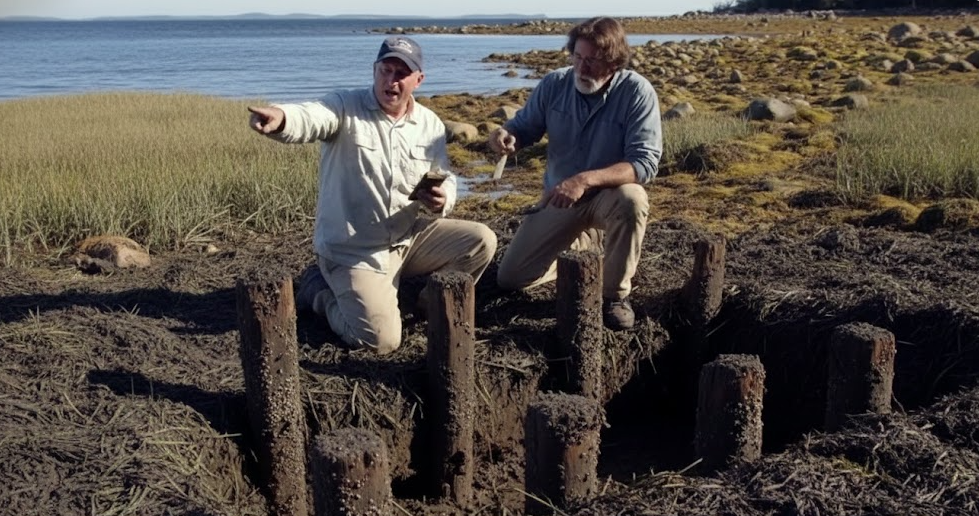
When viewed alongside medieval-style artifacts, Roman coins, Venetian beads, and engineered underground features, a troubling narrative emerges: Oak Island may have served as a secret maritime hub long before history acknowledged it.
Whoever came here had:
-
resources
-
engineering knowledge
-
and a reason to remain hidden
A Defining Moment for Season 13
As excavation and analysis continue in the western swamp, the evidence grows harder to dismiss. If confirmed, the dock would represent the first concrete proof of organized, intentional maritime activity on Oak Island centuries before the Money Pit legend.
Rick Lagina sums it up with quiet gravity:
“Whoever built this… they didn’t stumble onto Oak Island. They came here on purpose.”
Season 13 may not just be uncovering artifacts.
It may be exposing the infrastructure of secrecy itself.
And if Oak Island once welcomed ships in silence, the question now becomes unavoidable:
what arrived here—and why was it never meant to be seen?