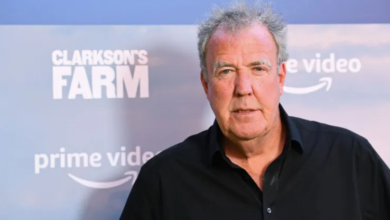
Inside Clarkson’s Farm: How Kaleb Cooper humbled Britain’s loudest man
Jeremy Clarkson and Kaleb Cooper: The unlikely partnership that redefined British farming television
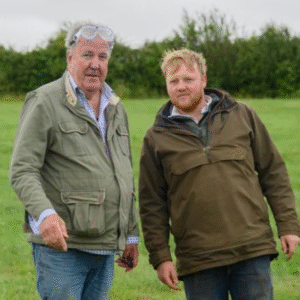
When Clarkson’s Farm first aired on Prime Video, few expected it to become a cultural phenomenon. Viewers tuned in for the familiar antics of Jeremy Clarkson, the outspoken former Top Gear host. What they discovered instead was something deeply human: a struggling farm, a baffled celebrity, and a young, sharp-tongued farmer named Kaleb Cooper who refused to take orders from anyone — even Clarkson himself.
Their unlikely partnership has since become the heart of the show. On screen, it looks like chaos — tractors breaking down, sheep escaping, Clarkson arguing about bureaucracy while Kaleb mutters “you’ve done it wrong again.” Yet beneath the humor lies a rare glimpse into Britain’s agricultural reality: long hours, unpredictable weather, mounting costs, and an industry often left behind by politics.
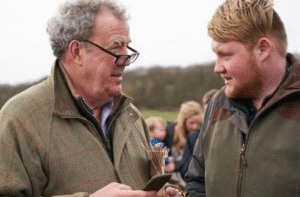
Kaleb, just in his twenties when filming began, embodies a generation fighting to keep farming alive. His blunt honesty and deep knowledge of the land have made him an unexpected national voice for farmers who feel unseen. “It’s not just about tractors,” he once said in an interview. “It’s about a way of life we’re trying to protect.”
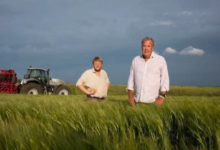
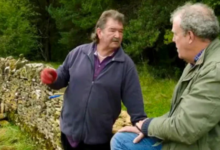
Clarkson, for his part, entered farming almost by accident. When COVID-19 halted filming of The Grand Tour, he turned his 1,000-acre Diddly Squat Farm in Oxfordshire into both a project and a passion. What began as a hobby soon revealed the brutal economics of modern agriculture. Despite his fame and resources, Clarkson struggled to make profit. Red tape, bad weather, and falling prices repeatedly humbled him. “If you think farming is easy,” he joked, “try doing it with tractors that constantly break down.”
The genius of Clarkson’s Farm lies in how it balances comedy and candor. It’s not just a celebrity experiment—it’s a portrait of rural Britain, told through two men who couldn’t be more different. Clarkson, brash and ambitious, represents modern impatience. Kaleb, patient and precise, represents tradition and discipline. Together, they create a dynamic that feels both entertaining and strangely moving.
Their relationship, often filled with bickering, has become a symbol of generational contrast. Yet, there is mutual respect beneath every argument. “Jeremy’s stubborn,” Kaleb once admitted, “but he listens — eventually.” Clarkson, in turn, calls Kaleb “the boss of the farm,” acknowledging his expertise even while teasing him on camera.
Beyond the humor, the series has sparked a national conversation about how little farmers earn, the pressures of environmental policies, and the uncertain future of young people in the countryside. Kaleb has since published a book and spoken at agricultural events across the UK, while Clarkson has become an unlikely advocate for farmers’ rights.
But their story isn’t just about farming. It’s about resilience, ego, and learning to listen. Clarkson’s celebrity meets Kaleb’s authenticity, and together they turn Diddly Squat Farm into a microcosm of Britain’s rural struggle — and its stubborn hope.
Season after season, the show proves that even in mud, machinery, and mayhem, there’s room for humility. And perhaps that’s the biggest surprise of all: that Jeremy Clarkson, once known for roaring engines, found his most meaningful battles not on the racetrack, but in the quiet, unforgiving fields of Chipping Norton.
The next season of Clarkson’s Farm is already in production, and fans are eager to see how the pair handle new challenges — from rising taxes to environmental demands. Whatever happens, one thing is certain: Kaleb will still be shouting, and Clarkson will still be laughing.