Parker’s Biggest Season Yet Collides With Tony’s Bold Return – Who Really Holds the Power Now?
“We’ve never tried to go for this big of a season. We’ve never gone through this much ground that we’re supposed to go through this year.”
Inside Parker Schnabel’s camp, that sentence is not just hype. It is the warning label on a season that could either redefine his career or break it.

Over the Klondike, the air is thick with dust, diesel and something no camera can truly show: pressure. Gold prices hover near record highs. One good season can change a life. One bad one can cripple an entire mining empire.
At the heart of this pressure cooker stand two familiar rivals. On one side is Parker Schnabel, chasing the biggest gold total of a career built on aggressive risk. On the other is Tony Beets, the long-time “King of the Klondike”, trying to pull a wounded family business back from the edge.



Yet the most decisive move of this story is not a flashy new wash plant or a giant new claim. It is a single piece of steel travelling quietly from one yard to another – a part that becomes a lifeline, a message and a weapon, all at the same time.
Parker’s 10,000-ounce dream – and a nightmare start
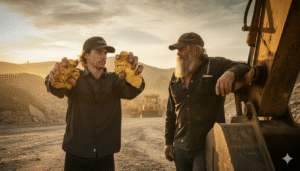
Parker enters the new season with a target that sounds almost impossible: 10,000 ounces of gold from his Dominion Creek claim. At today’s prices, that much gold is worth more than $25 million.
The number is not random. It grows out of what happened the previous year, when Dominion Creek produced about 4,500 ounces and convinced Parker that the rich pay streak running through that ground is not finished yet. The belief is that it continues north into one long strip of exposed pay dirt known as the Long Cut.
If the Long Cut holds, the 10,000-ounce dream might not be fantasy. But the maths is brutal. To get there in roughly six months, the crew has to average more than 430 ounces a week. Six months of intense work with almost no margin for breakdowns, slow days or big mistakes. Every hour of sluicing matters. Every hour of downtime drags the numbers in the wrong direction.
To build early momentum, Parker wants a quick, low-risk win. The plan is straightforward on paper: fire up Big Red – the trusted wash plant from past victories – and re-wash old tailings left behind by a previous operator. Those piles are not fresh pay dirt, but in theory they still contain missed gold. With prices so high, even thin leftovers could give the crew a decent first cleanup and boost confidence in the 10,000-ounce target.
Big Red is moved into position piece by piece. Conveyors are aligned, hoses are connected, the feeder is set. For 34 hours, belts turn, water roars down the sluice boxes and dark, wet gravel slides across the riffles. The crew watches the mats and tries to keep machines running without a single major failure.
Everyone knows this first cleanup will set the tone. A strong result could make the target feel real. A weak one could make it feel impossibly far away.
When the run ends and the plant falls silent, months of planning and spending narrow down to a single number. Concentrates are collected, cleaned and weighed.
The result is a shock: just 5.6 ounces of gold, worth around $14,000.
For a small operation, that might be acceptable. For a crew trying to hit 10,000 ounces in six months, it is a disaster. The plant that was supposed to deliver a quick early win instead produces the worst first cleanup the crew has ever seen. Fuel, time and labour have been burned for a result that barely touches the massive target.
The mood drops instantly. Everyone knows the weekly average they must hit. Instead of starting on pace, the team begins the season already behind. It is not just a bad cleanup. It is a warning that this season may not care about previous success or best-laid plans.
Tony’s rescue mission and the “comeback cut”
While Parker wrestles with how to recover from a terrible opener, another camp in the Klondike is about to send a very different message: the king is not ready to step aside.
On the Indian River claim, the Beets operation is facing its own make-or-break year. The previous season finished roughly 3,000 ounces short of the goal and left the business an estimated $6–7 million in the hole. Machines, money and relationships all took damage. The family is strained under the weight of constant stress.
For Tony Beets, this season is not a routine campaign. It is a rescue mission. The new target is 5,000 ounces from ground he trusts on Indian River – enough, if he can reach it, to start patching up the financial mess and prove that the Beets name still carries real weight in the Klondike.
Crucially, the key move for this comeback season began long before the thaw. At the end of last year, Tony made a bold call on a 10-acre zone that would become known as the “comeback cut”. Instead of leaving it dry, he deliberately flooded the ground with water. When the Yukon winter arrived, that water froze into a thick, two-foot-deep layer of ice.
The logic was clever. The ice would act like a lid, trapping heat in the ground below and slowing the deep freeze. If it worked, the pay dirt under the ice would remain soft enough to mine much earlier than elsewhere, giving the Beets operation a vital head start.
If it failed, the result would be a giant frozen block that could leave the entire cut unusable for weeks.
As spring arrives, the gamble is tested. A huge dozer rolls into the comeback cut, shoving aside the ice blanket. The real test comes when the ripper shank drops deep into the exposed ground. If the soil is rock hard, the plan has failed.
Instead, the ground gives way. The pay dirt beneath the ice is thawed and workable. The frozen gamble has paid off.
Almost immediately, Indian River comes alive. Trucks haul thawed dirt to the wash plant. The screens shake, water pours through the sluices and the early advantage begins to convert into real ounces.
After a full week of running, the first cleanup from the comeback cut is ready. The Beets family gathers around the table – everyone except eldest son Kevin. The gold is melted, shaped and weighed. The number climbs to 312.6 ounces. At roughly $2,500 per ounce, the first week’s run is worth more than $750,000.
It is the biggest first cleanup the Beets family has ever produced.
The strategy that looked risky months earlier has turned last season’s pain into this season’s power. The machines are making money again, and the long-time king of the Klondike shows he can still combine experience and risk to deliver huge results.
But even in that moment of triumph, the empty space where Kevin would normally stand tells its own story. The business may be bouncing back. The family is still divided.
Scribner Creek: Kevin’s tightrope between legacy and independence
Just over the hills, on the 44-acre Scribner Creek claim, that missing member of the Beets clan is working on a mine of his own.
Here, Kevin Beets is no longer just part of his father’s crew. He is the boss.
The claim is leased from Tony, but the mining project belongs to Kevin and his partner Faith. Their plan is clear: start a new mine from the ground up, aim for around 1,000 ounces of gold and prove that a Beets can run a tight, efficient operation without the old family chaos.
The pressure is intensely personal. Every success and every failure at Scribner Creek lands directly on Kevin’s shoulders.
Starting from zero means there is no luxury of a brand-new fleet. Scribner Creek relies heavily on used machines, many borrowed from the Beets operation. On paper, it looks like support. In reality, a crucial missing piece throws everything into doubt.
A massive D10 dozer arrives on site, intended to be the workhorse for an 11-acre zone known as the Lynx Cut. Its job is to rip open frozen ground and expose the pay layer. Without deep ripping, the pay dirt stays locked under tough muck and the entire mining plan stalls.
At first glance, the arrival of the D10 looks like a big win. But when Kevin and the crew inspect it closely, they find a serious problem. The 10-foot steel ripper shank that should hang off the back is missing.
Without that ripper, the D10 can push piles around but cannot open the cut. The machine that should be the heart of the mining plan is only half equipped. The Lynx Cut depends on that piece of steel. Without it, every schedule and every plan begins to fall apart.
Whether the missing ripper is a simple oversight or a quiet way of keeping control is unclear. What is clear is the effect: no ripping means no stripped ground; no stripped ground means no pay dirt; no pay dirt means no gold. Each day without a fix adds more strain to the budget and momentum of the new mine.
To increase his chances, Kevin has brought in help from outside the family – Brennan Ruault, a highly experienced dirt mover with years in the Klondike. Brennan once spent six seasons as a foreman on Parker Schnabel’s crew. Their partnership ended on rough terms, but the knowledge he gained is still valuable. He knows the area, the ground and the style of mining used in big operations.
There is a small twist of fate in the location. The Scribner Creek claim sits just beyond a line of trees from where Brennan first worked for Parker. The land itself carries memories of his early days in the Klondike.
Even with that experience on site, the mine remains frozen in place. The missing ripper turns from a problem into a crisis.