Secrets Beneath Two Kingdoms: The Clues Linking Oak Island to Europe
More than 3,200 miles from Nova Scotia, inside the damp stone corridors of Valkenburg Castle in the Netherlands, a centuries-old mystery is taking on new shape. Rick Lagina and his research team, known globally for their years-long investigation into the Oak Island enigma, have arrived in Europe with a singular purpose: to test whether a medieval alliance between the Knights Templar and Viking seafarers could explain some of the most perplexing discoveries found on the island.
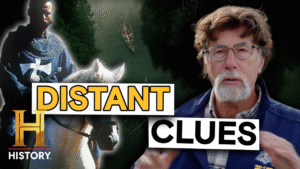
Their guide, historian Jacquo Silvertant, leads them deep beneath the 12th-century fortress. Here, carved onto the walls of a dungeon where Templar knights were once imprisoned, lie symbols that have resurfaced in unexpected places — including on Oak Island itself. Among them: the four-dot cross and the enigmatic “goose paw,” both long associated with the Templar order.
For researcher Corjan Mol, the match is unmistakable. “We’ve seen these symbols throughout Europe,” he notes, “and now, aligned with what we found in Nova Scotia, they strengthen a trail we’ve been following for years.”
The revelations do not stop at symbols. On another section of the ancient wall, the team identifies a crude outline of a two-masted ship — a design believed to be used by Norse sailors during the medieval period. If genuine, the carving may echo an increasingly compelling theory: that the Templars relied on Viking navigators to flee Europe after the order was suppressed in 1307, carrying with them priceless treasures said to include relics from King Solomon’s Temple.


To explore the possibility further, the team heads north to the Ladby Viking Museum in Denmark. There, museum curator Ane Jepsen Nyborg examines a medieval iron arrowhead discovered on Oak Island in the 1960s. Her reaction is immediate. The object, she explains, is “quintessentially Viking,” consistent with Norse craftsmanship from around AD 800 to the late 1200s — centuries earlier than most accepted timelines for European presence in the region.
Such an artifact, if conclusively traced to Scandinavia, could help explain the 13th-century dates that persistently emerge from scientific analyses of Oak Island’s structures and artifacts. It may also lend credibility to research suggesting that Norse descendants had the maritime skill — and the reach — to guide secretive voyages across the Atlantic.
The trail continues west across the ocean to L’Anse aux Meadows in Newfoundland, the only verified Viking settlement in North America. Here, archaeologists remind the Oak Island team that evidence of Norse movement goes far beyond the site’s reconstructed longhouses. Butternuts — which grow naturally only as far north as New Brunswick and Nova Scotia — were found at the settlement, proving the Vikings ventured deeper into Atlantic Canada than previously confirmed.
The implications for Oak Island are significant. If Norse explorers travelled southward along the Atlantic coastline, they may well have reached the shores of Nova Scotia — and perhaps the island that has captivated treasure hunters for more than two centuries.
Inside a reconstructed forge, a blacksmith trained in Viking-age techniques inspects replicas of arrowheads identical to the Oak Island find. Nearby, archaeometallurgist Emma Culligan prepares comparative tests using bog iron, a material that Vikings commonly worked and that Oak Island’s swamp could feasibly produce.
For the Laginas and their team, the journey across Europe and back to North America has produced something rare in the world of historical investigation: convergence. Medieval symbols in a Dutch dungeon, a Viking-era weapon point in Nova Scotia, archaeological proof of Norse travel into Atlantic Canada, and multiple scientific datings pointing squarely to the 1200s — all now appear to intersect.
No one claims the mystery is solved. But as Rick Lagina puts it, “If we can confirm a corridor from Europe to Oak Island during the medieval period, we may finally understand how this story began.”
And for followers of this centuries-old puzzle, one thing is clear: the truth, once uncovered, may be far stranger — and far older — than anyone imagined.