A Masonic Secret on the One-Dollar Bill? The Oak Island Link That Changes Everything
Oak Island Solved? The Roosevelt Theory That Rewrites American History
For more than two centuries, Oak Island has been the stage where treasure hunters, historians, engineers, and dreamers have confronted one maddening question: what exactly happened here?
Now, a provocative historical theory suggests the mystery may have been solved long before television crews, drilling rigs, or modern treasure hunters ever arrived — and the answer may have been quietly encoded into the most ordinary object in American life: the one-dollar bill.
According to researcher Alan M. Aszkler, President Franklin D. Roosevelt not only understood the origin of the Oak Island treasure but believed the secret was already woven into the very symbols of the United States. If true, this theory does not merely reinterpret Oak Island. It reframes the birth of America itself.
A Treasure Hidden — and Recovered — Before the Revolution?
The central claim is bold:
Freemasons in early America knew of the Oak Island treasure, recovered it, and used it to help finance the American Revolution.
Historical context makes this idea less far-fetched than it sounds. Many Founding Fathers were Freemasons. Many were deeply influenced by European esoteric traditions, enlightenment symbolism, and classical architecture. If a vast trove of gold, manuscripts, or sacred objects was recovered in secret during the 18th century, the Freemasons would have been uniquely positioned to guard — and deploy — such wealth.

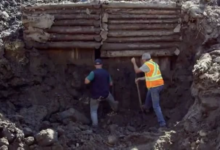

The phrase “Novus Ordo Seclorum”, appearing beneath the pyramid on the Great Seal, translates to “A New Order of the Ages.”
According to this theory, it references not only the dawn of American independence in 1776 but a deeper act of providence: Freemasons using a recovered treasure to birth a new nation.
Roosevelt’s Visit — And Roosevelt’s Symbols
Franklin D. Roosevelt was not merely a president. He was a lifelong Freemason and a man who took personal interest in Oak Island. Before rising to the presidency, he made inquiries, collected documents, and even visited the region to investigate whether early treasure hunters had left anything behind.
Then came 1935.
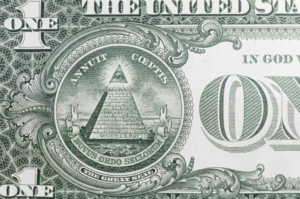
Under Roosevelt’s administration, the Great Seal of the United States was placed prominently on the redesigned $1 Federal Reserve Note. It is here, the theory argues, that Roosevelt deliberately encoded the Oak Island story.
Consider the symbolism:
● The pyramid
A structure rising from a swampy base — not unlike the enigmatic engineered layers described at the Money Pit.
● The Eye of Providence
Interpreted widely as divine guidance, but here suggested as a hint toward a divinely inspired recovery of a sacred treasure.
● MDCCLXXVI (1776)
The year engraved on the pyramid’s base — the year the new nation was born, allegedly with treasure already flowing beneath the political surface.
● Annuit Cœptis
“He has favored our undertakings.”
Did this refer to the Revolution — or to the secret mission that financed it?
● Novus Ordo Seclorum
A new American order made possible, according to this theory, by treasure retrieved from the depths of Oak Island.
The One-Dollar Bill: A Map in Plain Sight?
One of the most striking claims involves the design proportions of the note. The width of the words “ONE DOLLAR” — exactly 89 mm — supposedly “blinks” the eye from the Great Seal to the pyramid, a symbolic connection between the official emblem of America and a buried treasure beneath an island swamp.
Then there is the famous botanical controversy.
The Chestnut Leaves That Roosevelt Ordered Removed
During prototype sketches, early engravers included chestnut leaves and blossoms on the left side of the note.
FDR personally ordered them removed.
Why?
Aszkler argues:
because Roosevelt knew Oak Island treasure chests were made of chestnut wood.
Leaving the leaves on the bill would have been too obvious.
A Nation Built With Mystery?
November 30, 1782 — the preliminary signing of the Treaty of Paris — marked the moment the United States actually became free from British control.
The theory suggests that the treasure, already in Masonic possession, helped sustain the revolution until victory became unavoidable.
If this interpretation is correct, Oak Island is not merely a puzzle.
It is a lost chapter in the founding of the United States.
Mystery Solved? Or Mystery Reborn?
The idea that the treasure was recovered centuries ago — and hidden in plain sight through national symbolism — is controversial.
Mainstream historians do not accept it.
Traditional Oak Island researchers remain divided.
But the symbols remain.
The history remains.
And the dollar bill, held daily by millions, may yet be the boldest clue of all.
“The Treasure was recovered by Freemasons and used to create America.”
© Alan M. Aszkler
Whether fact, interpretation, or tantalizing coincidence, this theory gives Oak Island something it has not had in a long time:
a possible ending.