Hidden Tunnels or Ancient Engineering? New Collapse on Oak Island Points to a Deeper Secret
For more than two centuries, Oak Island has been a battleground between human determination and a landscape engineered—at least according to legend—to thwart anyone who dares approach the so-called Money Pit. This week, that struggle resurfaced dramatically when members of the fellowship discovered a sudden rush of water, unstable ground, and what appears to be a buried wooden structure deep beneath the uplands near Smith’s Cove.
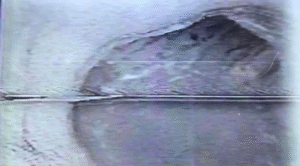
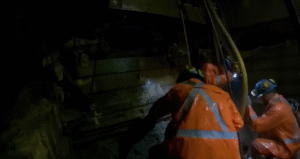
The moment began quietly. While inspecting an excavation area believed to be connected to a long-rumoured flood tunnel system, geologist Craig Tester and crew member Jack Begley noticed water pushing upward from the base of a freshly opened cavity. Within seconds, the seepage intensified into what Jack described as “a geyser,” forcing the team to pull back.
To veteran treasure hunter Marty Lagina, who rushed in to examine the site, the scene was familiar—and worrying. “What I see and hear is a lot of water rushing in from the landward side,” he said. “This is very impressive, but the ground is not stable.”
Their concern was justified. As the crew stepped away, cracks began forming across the edge of the cavity. Moments later, sections of the wall collapsed outright. Heavy machinery operator Billy Gerhardt warned the entire bridge of soil could give way. The team evacuated immediately.

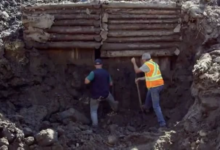

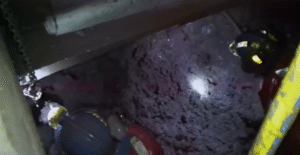
The collapse, while alarming, also delivered crucial information. For years, researchers have relied on seismic surveys suggesting a large tunnel or void cuts across the uplands toward Smith’s Cove—the same area once home to the notorious booby-trap system believed to flood the Money Pit. The sudden movement of water appeared to support that theory.
To investigate safely, the team mounted a camera on the arm of Billy’s excavator, lowering it into the unstable shaft. The resulting footage startled everyone: wooden boards, beams, and what appeared to be double-walled structures—features unlikely to be natural.
“Is it a tunnel that’s been filled with rock?” Marty asked during a later review in the War Room. “It looks like original work to me.”
Craig Tester agreed. “If the dendrochronology shows this wood predates the Money Pit discovery, then we may finally be looking at the real flood tunnel.”
But time was not on their side. The following day, contractors were scheduled to dismantle the massive steel cofferdam surrounding Smith’s Cove. Once equipment rolls in, the team will lose access to the area for months. With permits expiring, excavation must pause.
Still, the season was far from over.
In the Money Pit itself, drilling continued in a newly identified target zone known as the “Golden Egg”—a narrow area where scientific analysis has repeatedly shown spikes in gold-related metals. At a depth of around 100 feet, the drill encountered soft material and an abrupt shift in resistance, suggesting proximity to a cavity or structure.
More intrigue followed hours later when geoscientist Dr. Ian Spooner reported hearing deep, rhythmic “booming” sounds from inside the borehole—evidence, he believes, of an underground collapse or shifting air pocket. “There has to be a void down there,” he said. “Something is open.”
Meanwhile, another branch of the investigation is drawing the team far beyond Oak Island’s shores. After the recent discovery of an additional Roman coin and several artifacts of possible Scandinavian origin, researchers Doug Crowell and Emiliano Trocaro proposed a journey to L’Anse aux Meadows, the only verified Viking settlement in North America.
“If that site remained hidden until the 1960s,” Doug noted, “there’s no reason to believe it was the only one.”
For the Oak Island team, the link between Viking descendants, medieval travelers, and Old World knowledge has become increasingly difficult to ignore. Their working theory suggests that Norse explorers—or those who inherited their seafaring routes—may have played a role in bringing a valuable cargo to Nova Scotia centuries before modern searchers arrived.
Back on the island, uncertainty remains. Access to Smith’s Cove is suspended. The flood tunnel is still out of reach. And though signs of a nearby chamber continue to mount, no one can yet declare victory.
But if the past week proved anything, it is that Oak Island remains restless. Water surges, ground collapses, wooden structures emerge from the dark—and every new clue seems to pull the mystery toward a long-awaited tipping point.
As Rick Lagina put it, surveying the latest evidence: “We’re not giving up. Not even close.”