Oak Island: A Massive Chain Discovery Changes Everything (S13) | The Curse of Oak Island
Oak Island Team Identifies 17th-Century Iron Chain Linked to Mysterious Lot 8 Boulder
A newly analysed iron chain uncovered on Lot 8 of Oak Island has added a significant new layer to the long-running investigation into the island’s past, with experts confirming the artefact likely dates back to the 16th or 17th century.
The discovery was made by metal-detecting specialist Gary Drayton and surveyor Scott Barlow, working near a large stone boulder that has already raised questions about deliberate human activity on the site. The find comes as the Oak Island research team continues to refine a heat-mapping system to organise artefacts by location, depth, and estimated age.
While initial signals in the area produced everyday debris, including a spent shotgun shell and fragments of lead, a strong non-ferrous hit near the boulder quickly drew attention. Excavation revealed several oval-linked sections of iron chain, immediately recognised by the team as potentially significant.
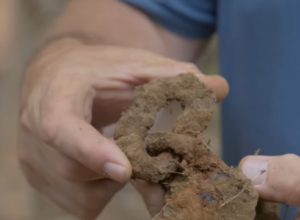
“These oval links are old,” Drayton noted at the site, pointing out that similar chain designs have existed since Roman times. “Chains are used for pulling and hauling. If this is connected to that boulder, it could help explain how it got there.”

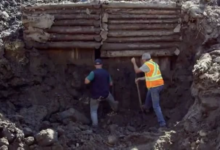

The boulder in question, located on Lot 8, is estimated to weigh tens of thousands of pounds. Previous investigation suggests it may have been deliberately placed atop a ring of smaller stones, rather than resting naturally. Nearby discoveries, including ox shoes found in alignment toward the feature, had already suggested heavy hauling activity using animal power.
The chain was transported to the Oak Island laboratory for detailed examination by materials scientist Emma Culligan, whose analysis proved pivotal.
CT scans showed the links were hand-forged, with no evidence of modern welding or butt-ended seams. Chemical testing revealed the iron was exceptionally pure, averaging around 99 percent, a composition characteristic of pre-industrial iron production.
“These are good signs for a pre-1800s date range,” Culligan explained. “Based on the composition and trace elements like phosphorus, I’d say this chain comfortably dates to the 1600s, and it could potentially go back to the 1500s.”

Wear patterns on the links also indicated prolonged heavy use. According to Barlow, thinning along the curves suggested the chain had been subjected to substantial strain over time. “If you were moving a 50,000-pound boulder,” he said, “this is exactly the kind of wear you’d expect to see.”
The findings prompted further discussion among the wider Oak Island team, including Rick Lagina and archaeologist Laird Niven. Lagina noted that the dating aligns with known historical activity in the region during the early colonial period.
“Those dates certainly align with the Knights of Malta,” Lagina observed, referencing historical records that place members of the order in Atlantic Canada during the 17th century. Niven confirmed that the proposed timeline fits documented activity at Fort Point and nearby coastal sites.
The team also raised the possibility of a connection to Isaac de Razilly, a French colonial officer associated with early settlement and military logistics in Acadia. Previous Oak Island theories have suggested that two missing chests believed to belong to de Razilly may have been transported or concealed using large-scale hauling methods.
Although no conclusions have been drawn, the proximity of the chain to the boulder, combined with the earlier discovery of a flintlock and other period artefacts on Lot 8, has strengthened the case for deliberate construction or concealment activity in the area.
“What’s important is that this isn’t an isolated find,” Lagina said. “We’re seeing multiple artefacts in close proximity that all suggest manipulation by human hands.”
The team emphasised that further excavation is needed, particularly beneath and around the boulder itself, to determine whether the chain was used to move the stone, lower objects into a shaft, or support some other structure now lost to time.
For now, the chain stands as one of the most compelling physical links yet between Oak Island’s enigmatic features and documented human activity from centuries ago. As work resumes on Lot 8, researchers hope additional discoveries will clarify whether the boulder conceals a shaft, an interment, or something of historical importance still hidden beneath the surface.
“What’s underneath that boulder,” Lagina noted, “may finally tell us why it was put there in the first place.”