Oak Island: Rick Lagina Finds a Secret Hatch on Oak Island, Pointing to a Carefully Concealed Design
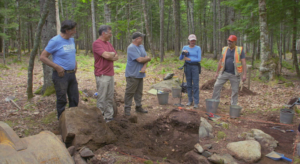
A newly identified square-shaped opening on Oak Island has prompted renewed scrutiny from researchers, raising fresh questions about the island’s long and complex history. The discovery, described by the team as a “hatch-like anomaly”, sits close to a modern roadway yet appears to align with features marked on centuries-old maps that have long fuelled speculation about the site.
For brothers Rick and Marty Lagina, who have spent years investigating Oak Island’s mysteries, the find represents another potential layer in a story that continues to resist simple explanation. While no conclusions have been drawn, the location and characteristics of the opening have shifted attention back toward historical maps and earlier interpretations of the island’s layout.
Maps that refuse to be ignored
Much of the renewed interest stems from research shared by the late Zena Halpern, a long-time investigator of possible Knights Templar connections to Oak Island. Halpern had introduced the team to two historic maps bearing unusual markings and coded references. One, dated to the late 12th century using Roman numerals, appeared to mark Oak Island directly. Another, a French map from the mid-14th century, included references to features resembling basins, dams and entry points.
Among the most puzzling elements were labels translated as “anchors”, “valve” and “hatch” — terms that have no clear meaning in a conventional archaeological context. For the Oak Island team, these words suggested mechanisms rather than landmarks, implying a functional system rather than random geography.


Aligning past and present
Using modern satellite imagery, team members compared Halpern’s maps with today’s shoreline and infrastructure. To their surprise, several reference points appeared to line up with contemporary features, including roads and property boundaries. One particular depression near a residential area drew attention after both the historical map and satellite data highlighted it independently.
Jack Begley, part of the research team, cautioned against premature conclusions. While the alignment was striking, the precise nature of what lay beneath remained unknown. Still, the possibility that the map accurately reflected the island’s layout centuries ago raised an unavoidable question: was the newly identified opening intentional?
A cautious archaeological response

Archaeologist Laird Niven was brought in to assess the site. His initial observations suggested that some stones around the opening may have been deliberately moved rather than naturally displaced. While this did not confirm the presence of a tunnel, it indicated potential human modification.
Marty Lagina acknowledged the implications but emphasised restraint. Any further excavation would require official permissions and adherence to archaeological regulations. Unlike earlier treasure hunters who worked with little oversight, the current team has consistently involved provincial authorities to ensure that investigations are conducted responsibly.
Oak Island, after all, is widely regarded not just as a treasure site but as a significant archaeological landscape.
Revisiting earlier failures
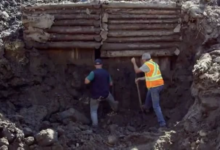
The discovery also revived interest in past attempts to access the island’s secrets. In the 1930s, treasure hunter Mel Chappell attempted to tunnel toward what he believed was the original Money Pit, only to be stopped by sudden flooding. Evidence of that failed effort was later encountered by the Lagina team during drilling operations decades later.
These historical efforts, once dismissed as misguided or speculative, are now being re-examined in light of new data. Each failed attempt appears to have left behind fragments of information rather than dead ends.
Nolan’s Cross and deeper symbolism
Beyond the hatch, the team also revisited Nolan’s Cross, a formation of large stones discovered in the 20th century by landowner Fred Nolan. The arrangement, which some believe resembles a cross, has been variously interpreted as a navigational marker, a symbolic structure, or a geometric coincidence.
Stone specialists examining the site noted unusual shaping on several of the granite cones, including smoother surfaces inconsistent with natural weathering. Some theories link the arrangement to medieval symbolism, while others suggest connections to ancient measurement systems. No consensus has been reached, but the cross continues to attract attention as a potential key to understanding the island’s design.
Questions without answers
At this stage, the newly discovered hatch remains unexplored. It may prove to be a natural feature altered over time, or it may be part of a broader system hinted at in historical maps. For Rick Lagina, the significance lies not in certainty, but in context.
Oak Island’s story, he has often said, is not about a single find, but about patterns that persist across centuries. Each anomaly, map and failed excavation adds another piece to a puzzle that resists closure.
Whether the hatch leads to a tunnel, a chamber, or nothing at all, it has once again forced researchers to confront a familiar reality. On Oak Island, every answer tends to generate new questions — and the ground rarely gives up its secrets easily.