Oak Island: Unexpected Jewel Unearthed on Oak Island Suggests a Carefully Concealed Legacy
For more than a decade, the team behind The Curse of Oak Island has pursued a mystery buried beneath the glacial soils of a small island off the coast of Nova Scotia. What began as a quest for a legendary treasure has gradually evolved into a complex historical investigation, drawing on archaeology, geology and advanced surveying technology.
As the programme enters the middle of its thirteenth season, a newly aired episode titled Into the Fold marks a significant shift in both tone and focus. Rather than centring solely on the recovery of valuables, the investigation now appears increasingly concerned with understanding who may have been active on Oak Island centuries ago, and why such extraordinary measures were taken to conceal their activities.
A significant find on Lot 5
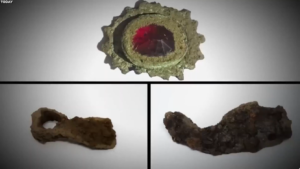
The episode’s most notable surface discovery comes from Lot 5, an area long overshadowed by the island’s infamous Money Pit. Recent excavations there have produced a dense concentration of artefacts, including stone features whose purpose remains unclear. During a metal-detecting sweep led by Gary Drayton, the team uncovered what appears to be a high-grade jewel.
Unlike many previous finds on the island — often corroded tools or fragments of industrial debris — the jewel suggests wealth and deliberate concealment. Initial assessments indicate it was crafted in the Old World, potentially linking Oak Island to European traditions of jewellery-making several centuries ago.


For Rick Lagina, who has led the project alongside his brother for nearly two decades, the discovery represents more than a visually striking artefact. If authenticated and dated, the jewel could offer rare physical evidence that individuals of considerable status once operated on the island, lending weight to theories that Oak Island played a role beyond colonial-era industry.
Beneath the surface: the solution channel
While the find on Lot 5 captures attention above ground, developments beneath the island may prove equally important. Drilling in the Money Pit area has identified what researchers describe as a “solution channel” — a natural void formed by the dissolution of limestone or anhydrite by groundwater.
In geological terms, such features are not unusual. However, within the context of Oak Island, solution channels have long been suspected of playing a role in the complex flooding that has frustrated excavations for more than two centuries. The team believes early builders may have exploited these natural cavities, integrating them into a defensive system designed to divert seawater into key shafts.
Recovering core samples from this channel provides new insight into the island’s subterranean structure. For the first time, researchers may be able to map the pathways that allow water to enter the Money Pit, potentially explaining how the original system functioned and how it might be safely navigated.
From treasure hunt to historical inquiry
The episode title Into the Fold appears to reflect this broader transition. Rather than chasing isolated objects, the team is increasingly focused on reconstructing a historical narrative — identifying who engineered the island’s features and what they sought to protect.
Marty Lagina has described the latest findings as taking the investigation “to a whole new level”. That assessment reflects a methodological change: the project is now guided less by trial-and-error excavation and more by targeted analysis of geological and archaeological data.
The mention of possible religious implications in the programme has reignited interest in long-standing theories linking Oak Island to the Knights Templar. Advocates of this hypothesis argue that members of the medieval order may have transported sacred or sensitive objects to the New World following their persecution in 14th-century Europe. While no definitive proof has emerged, the discovery of a high-quality jewel raises new questions about the island’s early visitors.
What comes next
As winter approaches in the programme’s timeline, the urgency of the investigation becomes clear. Each new artefact and core sample influences planning for the 2026 digging season, when the team hopes to apply its growing understanding of the island’s geology to more precise excavation strategies.
Crucially, the current phase of research suggests that Oak Island’s significance may not rest solely on material wealth. If the artefacts point towards a coordinated effort involving skilled engineering and symbolic objects, the island’s true value could lie in its historical implications rather than any recoverable treasure.
For viewers, Into the Fold represents a moment of transition. The evidence presented does not resolve the mystery of Oak Island, but it reframes it. The question is no longer simply whether something was hidden there, but whether the island itself was designed as part of a wider historical project whose meaning is only now beginning to emerge.