The Curse of Oak Island Season 13 Episode 4: The Swamp Reveals a Dark Secret No One Expected
Season 13 of The Curse of Oak Island continues to push deeper—both literally and historically—into a mystery that has challenged researchers for more than two centuries. Episode 4 stands out not because of a single breakthrough, but because of a striking convergence of clues scattered across the Money Pit, the western swamp, and Lot 5. Each location offers fragments of a much older story—one that now appears to stretch hundreds, even thousands of years before 1795.
A New Push into the Solution Channel
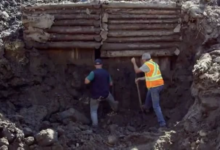
The episode’s most immediate action centers on borehole F5.5, drilled just seven feet from the high-yield F4. Water testing in the area has shown unusually elevated levels of gold and silver, making this new borehole a strategic attempt to penetrate the long-suspected “solution channel”—a natural void where heavy objects may have migrated over centuries of collapses and flooding.
When the drill retrieves a small, dense metal fragment, excitement briefly surges at the prospect of a coin. Though the object is ultimately identified as a carbide button from a modern drill bit, its presence reinforces something crucial: dense metal debris can travel downwards through disturbed fill until it settles at the bedrock interface. The physical validation of this process strengthens the theory that treasure—or remnants of it—may have slid into deeper voids over time.
Historical research further elevates the stakes. Reports of a 14th-century Portuguese coin found in the original Money Pit, combined with isotopic matches between earlier lead artifacts and medieval southern France, have renewed the team’s focus on pre-1700 European involvement—possibly even linked to Templar-connected groups.


The Western Swamp Reveals New Engineering
While the Money Pit digs downward, the swamp expands the story outward. Gary Drayton, Billy Gerhardt, and Rick Lagina uncover an unexpectedly dense field of wooden stakes clustered in a tight 50×50-foot zone. Their placement appears chaotic, yet their preservation suggests significant age.
Even more surprising is the sand layer beneath them—material that does not naturally accumulate in this part of the swamp. This strongly indicates human engineering.
The episode’s most striking swamp development comes with the discovery of a rock structure that mirrors the stone road and paved areas uncovered in previous seasons. Dr. Ian Spooner immediately recognizes the parallels: leveled stones, deliberate arrangements, and features consistent with organized medieval-era construction. Pending permit approvals, the team prepares to expand the excavation northward in search of architectural context that could unify multiple swamp discoveries.
Lot 5: The Unexpected Time Capsule
Once dismissed as farmland, Lot 5 continues to challenge assumptions about Oak Island’s early history.
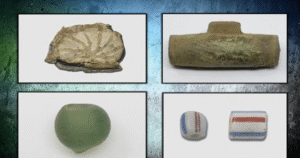
The first major analysis comes from Emma Culligan, who confirms that a lead artifact found near the lot’s rectangular foundation contains no modern alloys. Its purity places it around 1700 or earlier, and possibly within the same origin group as the medieval lead cross and the LeBertar token—both isotopically linked to 14th-century southern France. Laser ablation testing is ordered to confirm whether Lot 5 artifacts share the same medieval fingerprint.
A second discovery—a pair of heavily corroded iron fragments—initially suggests medieval horse tack. Laboratory work later identifies them as 17th-century shears, reinforcing evidence of European presence long before the Money Pit legend began.
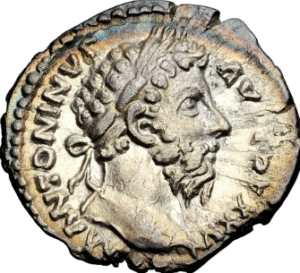
The most visually striking find is a circular stone feature built around an upright slab. Combined with the six Roman coins previously found nearby, the configuration hints at ceremonial, navigational, or boundary-related construction. The team prepares to bisect the formation to reveal its purpose and stratigraphy.
A Possible Early Firearm Component
As the episode closes, the swamp delivers a potential game-changer. Gary recovers a heavy iron fragment with a hollow end and diagonal rise—characteristics consistent with a petronel, a cavalry-used firearm from the 14th to 16th centuries. If confirmed by CT scan, it would be one of the earliest military artifacts ever recovered on Oak Island, suggesting that whoever operated here centuries ago may have been armed, organized, and acting with purpose.
A Converging Historical Narrative
Episode 4 does not hinge on a single revelatory find. Instead, its power lies in how multiple clues begin to align:
-
The Money Pit shows that dense artifacts truly can migrate into deep geological voids.
-
Lot 5 continues to yield pre-Money Pit European material, from lead pieces to Roman coins.
-
The western swamp reveals engineered structures echoing medieval construction techniques.
-
Artifacts from multiple centuries—Roman, medieval, 1600s—suggest repeated visits rather than a single deposit event.
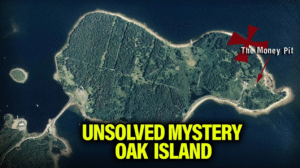
The geographic pattern is especially compelling. Lot 5, the Money Pit, and the swamp form a triangular zone rich with interlocking evidence. Structures in the swamp appear to align with pathways leading toward the Money Pit. Medieval-era lead links Lot 5 to Smith’s Cove. Roman coins emerge near stone circles that appear intentional.
Far from being an accidental collection of anomalies, Oak Island is starting to look like a deliberately engineered environment.
Toward a More Complex History
The episode signals a broader shift in the series: the mystery is no longer just about what may be buried beneath the Money Pit, but who operated on Oak Island—and why. The possibility of early Portuguese navigators, medieval European groups, or a Templar-associated enterprise is no longer fringe speculation but a scenario supported by emerging patterns.
Rather than a single treasure event, the evidence points toward overlapping phases of activity spanning centuries. Roads, paved areas, stake alignments, cobbled structures, charcoal deposits, early metalwork, and potential weapon fragments together suggest a coordinated, well-resourced effort.
Oak Island may not simply hide an artifact—it may conceal the story of an entire operation.
And after centuries of searching, Episode 4 hints that the team is closer than ever to understanding who shaped this island—and what they left behind.