Oak Island SHOCKER—Emma Culligan Identifies Evidence Linked to a $200M Treasure.
Claims that a Roman-engineered chamber has been identified deep beneath Oak Island have ignited fresh debate among fans of The Curse of Oak Island — but there is, at present, no verified evidence to support suggestions that North American history is about to be rewritten.
According to online speculation, geoscientist Emma Culligan — a member of the research team featured on the long-running History Channel series The Curse of Oak Island — has interpreted sonar and density scans as revealing a rectangular chamber approximately 140 feet below ground. The reports allege that the structure is lined with a metallic alloy consistent with Roman-era engineering and contains several dense objects resembling treasure chests.
However, no official statement from the production company, the network, or the Lagina brothers confirms the existence of such a discovery.
Oak Island and the Roman Theory

The Oak Island mystery, centred off the coast of Nova Scotia, has long attracted theories ranging from pirate treasure to Templar relics. Over more than a decade on television, Rick Lagina and Marty Lagina have pursued evidence of man-made structures, flood tunnels and buried vaults.
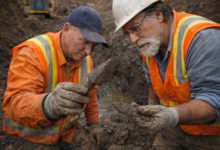
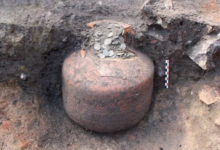
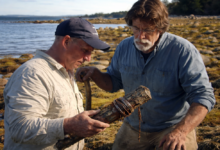
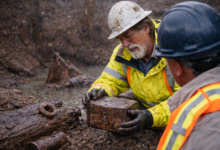
Previous seasons have featured artifacts described as Roman coins and other European objects, though many archaeologists caution that isolated finds do not constitute proof of Roman presence in North America. Mainstream scholarship maintains that there is no credible archaeological evidence that the Roman Empire reached the continent.
The latest rumours claim that isotope analysis of a lead-silver alloy matches Roman metallurgical signatures. Yet without peer-reviewed publication, independent laboratory verification, and controlled excavation context, such assertions remain unproven.
Engineering Claims Raise Questions
The reports further suggest that the alleged chamber measures roughly 10 by 15 feet and sits at a depth exceeding 140 feet — an extraordinary engineering feat if constructed in antiquity.
Experts note that sonar anomalies and ground-penetrating radar images can be difficult to interpret. Subsurface voids, geological fractures and mineral deposits can produce regular shapes in scans that appear artificial but are natural formations.
Moreover, extraordinary claims — particularly those that challenge established historical timelines — require equally extraordinary evidence. A Roman-engineered vault in Canada would represent one of the most significant archaeological discoveries in modern history. Such a finding would not remain confined to television production meetings or online forums; it would trigger international academic scrutiny.
The Role of Television Narrative
The Curse of Oak Island has built its success on incremental discoveries and evolving theories. The series often explores speculative possibilities while emphasising that investigations are ongoing.
Production pauses, selective footage, or heightened secrecy are not uncommon in reality television formats, particularly when narrative tension is central to audience engagement. That does not, in itself, confirm suppression of historically explosive material.
Emma Culligan, whose work on soil analysis and artifact examination has featured prominently in recent seasons, is known for measured, data-driven interpretations. To date, she has not publicly claimed proof of Roman construction beneath Oak Island.
A $200 Million Estimate?
Valuations circulating online suggest that any potential chamber could contain treasure worth $200 million. Such figures are speculative. Without confirmed contents, authenticated artifacts and market appraisal, assigning a monetary value is hypothetical at best.
If — and it remains a significant if — a sealed chamber were discovered, its historical importance could outweigh any financial assessment. Archaeologists would prioritise preservation, documentation and context over commercial valuation.
What Happens Next?
Season 13 of The Curse of Oak Island is expected to focus heavily on advanced drilling, borehole imaging and deeper exploration of previously identified anomalies. Whether those efforts reveal a constructed chamber remains to be seen.
For now, there is no verified evidence of a Roman vault, no confirmed metallic lining of imperial origin, and no authenticated cache of treasure at 140 feet.
Oak Island has endured as a mystery for more than two centuries precisely because it blurs the line between possibility and proof. The difference between the two is what ultimately defines history.
Until physical excavation, transparent scientific testing and peer-reviewed publication confirm otherwise, the story remains — as it has so often — a compelling theory awaiting decisive evidence.