The Woman Changing Oak Island Forever: How Emma Culligan Is Rewriting the Mystery
There is a new name on The Curse of Oak Island that is quietly changing everything.
In a world crowded with theories, legends and half-proven hunches, Emma Culligan stands out for a simple reason: she brings hard data to one of television’s most mysterious dig sites. With the mindset of an engineer, the curiosity of an archaeologist and the precision of a metallurgist, she has become one of the most influential figures on the island.
Viewers have watched her calmly feed artifacts into advanced machines, deliver quietly devastating lab results, and reshape long-held assumptions about what really lies under Oak Island. The question now is not just what the island is hiding – but how far Emma’s science can go in exposing it.
From Japanese Childhood to Canadian Dig Sites



Emma’s story does not begin in Nova Scotia or Newfoundland, but in Japan.
She grew up speaking Japanese as her first language, never imagining that one day she would be decoding centuries-old secrets on a Canadian island while working in English. She did not even start learning English until she was 15 – a point where many people would consider themselves too late to switch languages, let alone careers.
But Emma embraced the challenge.
Her path eventually led her to Dalhousie University in Halifax, Nova Scotia, where she began in engineering. That alone would have been a serious and respectable career. Instead, she chose something far less conventional. She transferred to Memorial University in Newfoundland and blended civil engineering with archaeology – a combination that looked unusual on paper but made perfect sense in practice.
One week she could be calculating structural loads.
The next, she might be handling ancient artifacts.
Her turning point came when a professor noticed her remarkable talent in chemistry and invited her to join a research group focused on metallurgy – the science of metals and their properties. That invitation pulled her deeper into material analysis, training her to read metals the way a historian reads manuscripts.
Those skills – engineering logic, archaeological context and chemical analysis – would later make her the ideal candidate for one of the most unusual jobs in television.
Joining The Curse of Oak Island
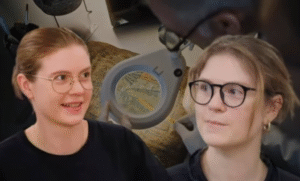
When Emma first heard from the production side of The Curse of Oak Island, she thought the offer might be fake. It is not every day that a globally known television series reaches out and asks if you want to help investigate a centuries-old mystery.
But the offer was real.
At first, someone involved with the show pictured her in a more administrative role. That idea vanished quickly once fellow archaeologist Laird Niven saw her CV. Instead of sitting behind a desk, Emma was offered something far more important: the chance to operate the island’s XRF system and other analytical tools.
On Oak Island, that meant one thing: she would become the person who could tell the team not just what they had found, but what it was truly made of – and what that might mean.
XRF, XRD and Turning Artifacts into Evidence
Emma’s work centres on technologies like X-ray fluorescence (XRF) and X-ray diffraction (XRD):
-
XRF allows her to determine the elemental composition of an object without damaging it.
-
XRD helps identify mineral structures and cement mixes, revealing how and when something was made.
For a show built on mystery, this kind of science is quietly revolutionary.
One of Emma’s early high-profile analyses involved a lead disc found on Lot 5. Using XRF, she discovered that it was not a simple, uniform piece of metal. It had distinct layers and a complex composition that hinted at origins far beyond the shores of Nova Scotia. Her work suggested that the metal could have come from regions as distant as Iran or Italy, raising the possibility that Oak Island is connected, directly or indirectly, to trade routes or movements far older and wider than previously assumed.
Then there was the now-famous gold reading from a wooden sample taken from the Garden Shaft. XRF revealed around 0.11% gold in what appeared to be an ordinary piece of timber. On its own, that number sounds small. In context, it is enormous: wood is not supposed to contain gold at all. The result instantly raised the prospect that material from a high-value deposit had once passed through or been stored in that shaft.
Emma’s work with XRD also changed how the team understood Smith’s Cove. A cement sample, long thought by some to be part of an original treasure-age structure, turned out under her analysis to contain Portlandite, pointing clearly to modern Portland cement. The dating placed it between the 1920s and 1970s – searcher activity, not original depositors.
Instead of supporting an ancient flood tunnel theory, that particular sample told a different story: generations of treasure hunters were literally cementing their own interventions into the island’s geology.
Roman Metal and a Coin That Rewrites Possibilities

Perhaps the single most talked-about example of Emma’s impact came with a small, weathered coin from Lot 5.
To an untrained eye, it could have been scrap metal. To Emma, it was a puzzle. Using XRF, she identified an unusual alloy: about 70% copper and 16% lead, unlike standard coinage compositions for more recent centuries.
The team’s working interpretation, based on Emma’s analysis, was extraordinary: the coin might date from around 200–300 AD, with potential links to Roman-era metalworking.
If that assessment is correct, it forces a radical question:
How did a coin with a Roman-style composition end up on a small island off the coast of Nova Scotia?
Emma did not claim to have all the answers. But her data gave the question real weight. Instead of speculation built on legend, the debate now included numbers, percentages and comparative metallurgy.
Cement, Stove Doors and the Human Story of the Island
Not all of Emma’s findings point to medieval knights or ancient empires. Some shine a light on the more recent, but equally important, human history of Oak Island.
Her analysis of a cast iron stove door from Smith’s Cove dated it to the mid-1800s, aligning it with the era of early industrial-age searchers. Rather than being evidence of an original deposit, it became proof of how hard earlier teams had worked – and how intensely they had lived on the island.
The picture that emerges is layered:
-
Deep structures, mysterious flood systems and complex drains hint at an older engineering plan.
-
More recent cement, stove parts and tools tell the story of families like the Restalls and companies such as Truro, who fought the island’s geology in their own time.
Emma’s lab results help separate those layers instead of blending them into one confused tale.
Why Emma Matters – To the Team and to the Audience
Within the Oak Island team, Emma has changed more than just lab reports.
Her analyses allow the group to prioritise leads based on evidence rather than hope. A shaft that shows no unusual readings can be deprioritised; a tiny sliver of wood showing gold traces can pull resources in its direction. Excavation strategies are no longer guided only by old maps and stories, but by modern data.
For viewers, she brings something equally important: credibility.
In a series built around a legendary mystery, Emma’s presence reassures the audience that each find is being tested, questioned and challenged scientifically. She is calm where others are excitable, precise where others are speculative. Fans have responded by describing her as one of the most trusted voices on the island – someone whose words can shift the conversation more than any rumour.
Her path, from Japanese-speaking teenager to Canadian engineer, from archaeology student to metallurgical analyst on one of television’s most enduring treasure hunts, sends its own message:
You do not have to choose between science and story. On Oak Island, in Emma Culligan’s hands, science is the story.
And as long as she is there, quietly feeding the island’s secrets into her machines, one thing seems certain: the next breakthrough on Oak Island is just as likely to come from a lab report as from a shovel in the ground.